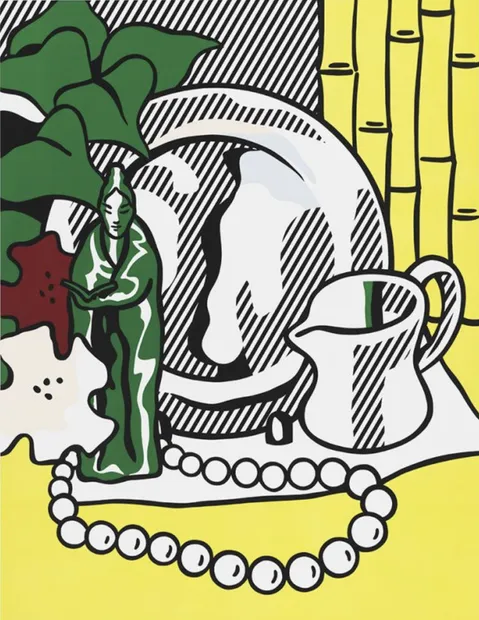
Still Life with Figurine, 1974: Lithograph and screenprint on paper

  • Roy Lichtenstein *Still Life with Figurine* (1974), featuring a stylised still life with a green figurine, pitcher, reflective vessel, beads, and foliage rendered in bold outlines, flat colour, and Ben-Day dots.
    Still Life with Figurine, 1974
    Lithograph and screenprint on BFK Rives paper, sheet: 118.6 x 95.8 cm
    Edition of 100; plus 14 AP
    ©The Estate of Roy Lichtenstein
     
    BACK TO: SIX STILL LIFE SERIES


    Still Life with Figurine, 1974, presents a carefully arranged composition of domestic and decorative objects rendered in Lichtenstein’s distinctive graphic style. At the centre, a plate dominates the scene, its curved surface defined by bold black outlines and diagonal hatching. To the right, a simplified pitcher echoes this form, while a string of beads curves across the foreground, anchoring the composition. On the left, a small green figurine stands upright beside stylised foliage, introducing a figurative element that contrasts with the otherwise object-based arrangement. Blocks of yellow, green, and red punctuate the image, while areas of linear shading flatten the space and emphasise surface over depth.
     
    Produced as a lithograph and screenprint on BFK Rives paper, the work forms part of Lichtenstein’s Six Still Lifes series, in which he reinterprets a traditional art historical genre through the visual language of Pop Art. Rather than focusing on illusionistic depth or painterly texture, Lichtenstein reduces each object to a system of lines, patterns, and colour fields. The result is a controlled and deliberate composition that questions the conventions of still life, transforming familiar objects into graphic signs while maintaining a balance between representation and abstraction.
  • "I'm a painter of the American way of life, and my way of painting is based on impersonality." 

     
    - Roy Lichtenstein
    Lichtenstein draws directly on the long tradition of still life painting, referencing the careful arrangement of objects seen in classical European art while stripping it of illusionistic depth and painterly texture. By reducing forms to bold outlines, flat colour, and mechanical patterns, he reinterprets the genre through the lens of Pop Art, turning familiar motifs into graphic signs.