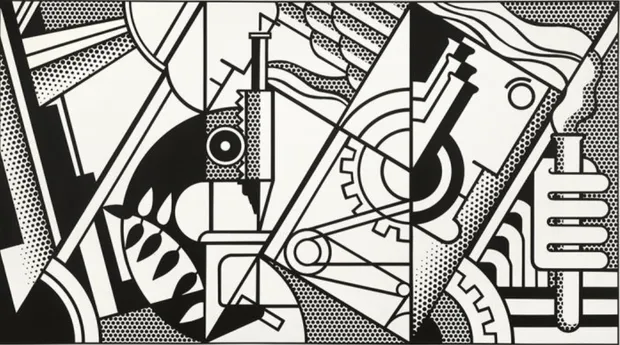
Peace Through Chemistry III, 1970: Lithograph on paper by Roy Lichtenstein

  • Roy Lichtenstein Peace Through Chemistry III (1970) monochrome lithograph featuring a triptych composition of machinery, cogs, and a stylised figure holding a test tube in black Ben-Day dots on white background.
    Peace Through Chemistry III, 1970
    Lithograph on Special Arjomari paper, sheets: 95.9 x 161.4 cm
    Edition of 16; plus 6 AP, 1 RTP, 1 PPII, 3 GEL, 1 C
    ©The Estate of Roy Lichtenstein
     
    BACK TO: PEACE THROUGH CHEMISTRY SERIES
     
    Peace Through Chemistry III, 1970, by Roy Lichtenstein presents a striking monochromatic variation within the series, reducing the composition to black Ben-Day dots and bold black outlines set against a white ground. Unlike the more vibrant earlier versions, this print strips away colour entirely, focusing attention on structure, form, and composition. The triptych-like division remains, with mechanical elements such as cogs, pipes, and wires interwoven with a stylised figure profile holding a test tube, all unified by a precise graphic system.
     
    By limiting the palette, Lichtenstein emphasises the image's underlying structure, allowing the viewer to focus on the balance between abstraction and figuration. The absence of colour heightens the contrast and clarity of each element, reinforcing his interest in mechanical reproduction and visual reduction. In this version, the composition becomes more analytical, demonstrating how the same image can shift in meaning and impact through controlled variation, a key principle throughout the Peace Through Chemistry series.
  • "I think the meaning of my work is that it is industrial, it's what all the world will soon become." 


    - Roy Lichtenstein

    Lichtenstein noted that an image like Peace Through Chemistry felt as though it should have existed in the 1920s and 1930s, yet never did. He brought together influences that had remained separate, such as American Precisionism, WPA mural painting, and modern European art, combining them through the lens of Pop Art and mechanical reproduction. In doing so, he created a new type of image that reflects both industrial modernity and twentieth-century visual systems.