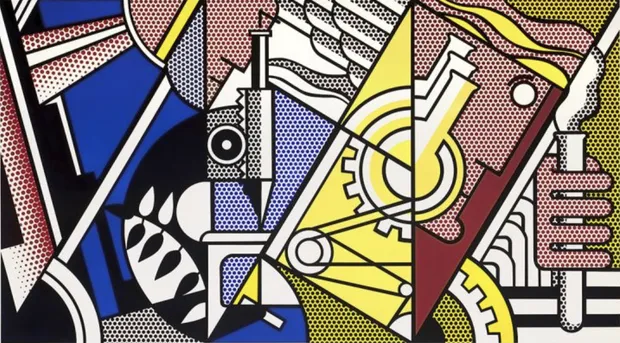
Peace Through Chemistry II, 1970: Lithograph and screenprint by Roy Lichtenstein

  • Roy Lichtenstein Peace Through Chemistry II (1970) print showing a triptych composition with blue, red, and yellow panels featuring machinery, cogs, and a stylised figure holding a test tube.
    Peace Through Chemistry II, 1970
    Lithograph and screenprint on Special Arjomari paper, sheet: 95 x 160 cm
    Edition of 43; plus 7 AP, 1 RTP, 1 PPII, 3 GEL, 1 C
    ©The Estate of Roy Lichtenstein
     
    BACK TO: PEACE THROUGH CHEMISTRY SERIES
     

    Peace Through Chemistry II, 1970, by Roy Lichtenstein is a more vibrant and visually complex development within the series, expanding the triptych structure with a richer colour palette. The left panel introduces a deep blue ground, contrasted with angular forms rendered in red Ben-Day dots, creating a sharper sense of depth and contrast. In the central panel, Lichtenstein builds a dense mechanical composition of cogs, pipes, and geometric elements, combining red, blue, and black Ben-Day patterns to emphasise movement and structural complexity.


    On the right, a stylised profile of a figure reappears, this time heightened through colour, with red Ben-Day dots defining the face, yellow hair adding brightness, and a red hand gripping a test tube. The intensified palette across the three panels reinforces the tension between human and machine, while the segmented composition maintains a clear, controlled visual system. Through this interplay of colour, pattern, and industrial imagery, Lichtenstein develops the series further, balancing abstraction and figuration within a bold Pop Art framework.

  • "Everybody has called Pop Art 'American' painting, but it's actually industrial painting." 


    - Roy Lichtenstein

    Across the Peace Through Chemistry series, Lichtenstein adopts a methodical and iterative approach, reworking a single core composition into multiple variations through shifts in colour, pattern, and emphasis. Rather than altering the structure dramatically, he tests how different palettes and Ben-Day dot configurations affect balance, clarity, and mood. This controlled repetition reflects his interest in mechanical reproduction and seriality, where each version operates both as an independent work and as part of a larger system.