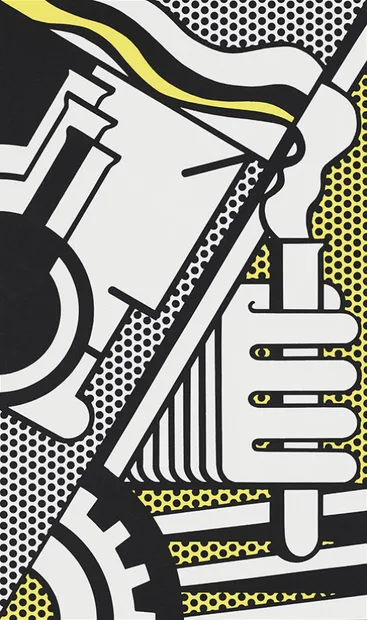
Chem IA, 1970: Screenprint on paper by Roy Lichtenstein

  • Roy Lichtenstein Chem I A (1970) screenprint featuring a stylised mechanical face in profile with test tubes, smoke, and industrial forms against dotted backgrounds.
    Chem IA, 1970
    Screenprint on Special Arjomari paper, sheet: 76.2 x 51.6 cm
    Edition of 100; plus 10 AP, 1 RTP, 1 PPII, 3 GEL, 1 C
    ©The Estate of Roy Lichtenstein
     
    BACK TO: PEACE THROUGH CHEMISTRY SERIES
     
    Chem I A, 1970, by Roy Lichtenstein, presents a stylised, mechanical figure constructed through bold outlines and Ben-Day dots. On the left, a simplified face is shown in profile, defined by an angular nose, small chin, and minimal features, including a single line for the eye and a slit for the mouth. Behind the figure, a series of laboratory test tubes emit smoke that doubles as hair, blending scientific imagery with human form. To the right, a hand-like shape holds a smoking test tube above an angular cog, reinforcing the fusion of organic and industrial elements.
     
    The composition is divided into contrasting fields, with a white background filled with black Ben-Day dots on the left and a yellow dotted ground on the right. This shift in colour and pattern enhances the sense of structure and balance, while emphasising Lichtenstein’s interest in mechanical reproduction and visual systems. By combining imagery associated with science, machinery, and the human body, Lichtenstein creates a controlled, graphic composition that reflects his broader exploration of technology, perception, and the language of Pop Art.
  • “I’ve never seen any painting like the Peace Through Chemistry image." 


    - Roy Lichtenstein

    Lichtenstein’s Peace Through Chemistry series (1970) explores themes of science, industry, and modernity through bold, structured compositions. Using segmented, triptych-like layouts, he combines scientific imagery with graphic forms, Ben-Day dots, and strong colour contrasts. The series reflects both the optimism of the industrial age and a more critical view of technology, highlighting the tension between human experience and scientific progress.