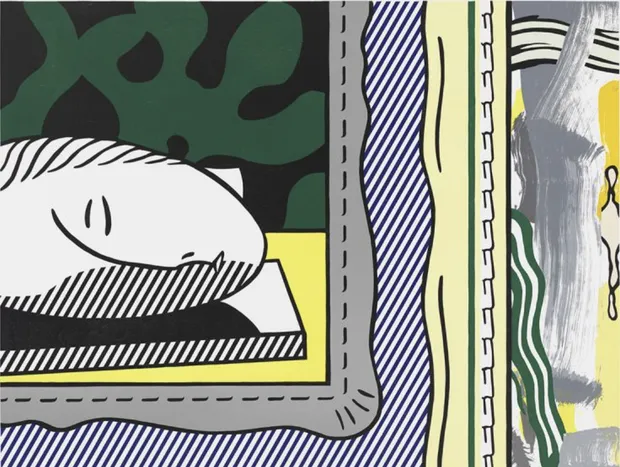
Two Paintings: Sleeping Muse, 1984: Roy Lichtenstein print from the "Paintings" series

  • Two Paintings: Sleeping Muse, 1984 is a print by Roy Lichtenstein from his "Paintings" series
    Two Paintings: Sleeping Muse, 1984
    Woodcut, lithograph, and screenprint on Arches 88 paper, Sheet: 96.2 x 124.3 cm
    Edition of 60; plus 11 AP, 1 RTP, 1 PPII, 3 GEL, 1 C, 1 NGA
    ©The Estate of Roy Lichtenstein
    BACK TO: "PAINTINGS" SERIES


    Two Paintings: Sleeping Muse, 1984 is a print by Roy Lichtenstein from the "Paintings" series, presenting two framed artworks set against a blue and white striped wall. Both frames are ornate yet rendered in flat colour, one in grey and the other in pale yellow, reinforcing Lichtenstein’s Pop Art approach of simplifying decorative elements. The composition focuses particularly on the left-hand painting, which depicts a stylised sculpture-like head of a sleeping woman resting on a short white plinth set upon a yellow floor.
     
    The elongated face is highly simplified, with a single vertical stripe forming the nose and a small line indicating the nostril that leads to a subtle mouth. A closed eye and eyebrow appear to the right of the nose, while short black strokes suggest strands of hair across the top of the head. Behind the figure, a dark black and green background contrasts with the pale tones of the sculpture. To the right of this image, a second framed work appears with loose grey and green brushstrokes, introducing a painterly element that contrasts with the more sculptural depiction of the muse. 
  • "Pop Art looks out into the world. It doesn't look like a painting of something; it looks like the thing itself."


    - Roy Lichtenstein

    Lichtenstein often simplified the human figure into bold shapes, flat colours and clear graphic lines. Rather than focusing on realistic detail, he reduced faces and bodies to essential visual elements such as a single curved line for a mouth, a simple stroke for a nose or areas of Ben-Day dots to suggest form. This approach allowed Lichtenstein to emphasise design, composition and visual impact rather than traditional modelling or shading. By stripping the figure down to these simplified components, he created images that feel both immediately recognisable and highly stylised.