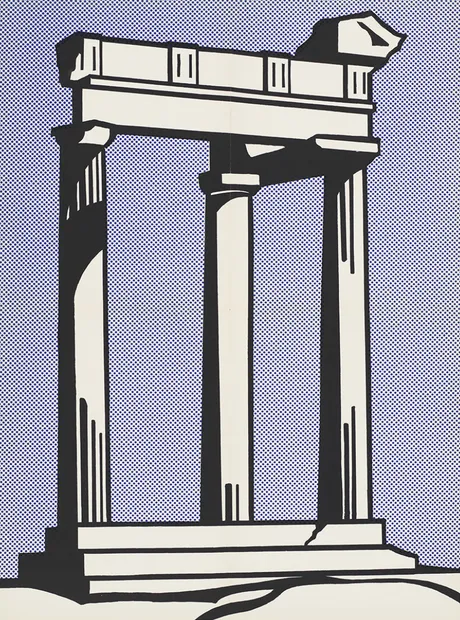
Temple, 1964: Print by Roy Lichtenstein

  • Temple, 1964 is a lithograph on wove paper by Roy Lichtenstein

    Temple, 1964

    Offset lithograph on smooth, cream wove paper

    Sheet: 23 3/4 x 17 3/4 in. (60.3 x 45.1 cm), Edition of 300; plus unknown number of mailers

    ©The Estate of Roy Lichtenstein

    BACK TO: LEO CASTELLI GALLERY PRINTS
     
    Roy Lichtenstein’s 1964 print was produced as an offset lithograph on smooth cream wove paper in an edition of 300, alongside an unknown number of exhibition mailers. Published by the Leo Castelli Gallery, New York, the work was issued in blue and black and is typically signed, dated and numbered in pencil in the lower right. The composition depicts a stark, temple-like structure rendered in white, set against a blue Ben-Day dot ground. A flight of steps rises from the foreground toward tall, simplified pillars that support the entablature, creating a monumental yet flattened architectural form characteristic of Lichtenstein’s graphic precision.
     
    In addition to the numbered impressions, the image was also circulated as an unsigned mailer announcing Lichtenstein’s October to November 1964 exhibition at Castelli, with gallery details printed on the reverse. This dual function as both editioned print and exhibition announcement situates the work firmly within his early Pop period and underscores its direct connection to the New York gallery scene of the 1960s.
  • "I'm excited about seeing things, and I'm interested in the way I think other people saw things."

     
    - Roy Lichtenstein
    Pop Art emerged in the late 1950s and early 1960s as artists began turning away from the introspective intensity of Abstract Expressionism and toward the imagery of mass culture. Drawing on advertising, comic strips, product packaging and celebrity photography, the movement embraced the visual language of modern consumer society. Rather than rejecting popular imagery, Pop artists recontextualised it, presenting familiar symbols with clarity, repetition and irony. By collapsing the boundary between high art and everyday culture, Pop Art became one of the most influential and commercially significant movements of the twentieth century, reshaping both museum practice and the global art market.