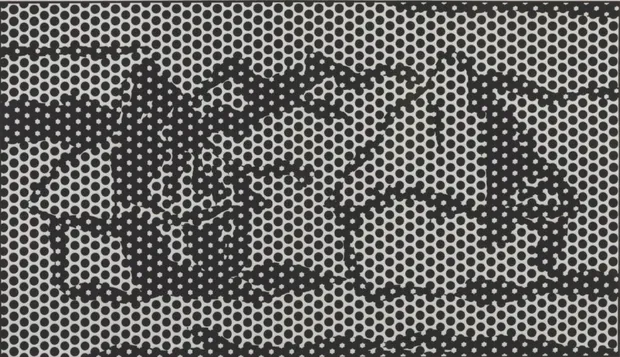
Haystack #7, 1969: Relief print on paper by Lichtenstein

  • Haystack #7 1969 is a print by Roy Lichtenstein depicting a black and white version of te Haystack series
    Haystack #7, 1969
    Relief print on Special Arjomari paper, sheets: 52.7 x 77.8 cm
    Edition of 100; plus 10 AP, 1 RTP, 1 PPII, 3 GEL, 1 C
    ©The Estate of Roy Lichtenstein
     
    BACK TO: HAYSTACK & CATHEDRAL SERIES
     
    Roy Lichtenstein’s Haystack #7 (1969) brings the Haystack series to a stark and resolved conclusion, reducing Claude Monet’s iconic motif to a monochromatic composition of black and white. Constructed entirely through Ben-Day dots, the haystack forms emerge through shifts in density and contrast, stripping the image of colour and focusing purely on structure and pattern. The result is a highly distilled interpretation, where the subject is defined with maximum clarity.
     
    By eliminating colour altogether, Lichtenstein emphasises the underlying mechanics of image construction, foregrounding repetition, contrast, and visual perception. This final work functions almost as a culmination of the series, moving from vibrant colour explorations to a complete reduction of means. In doing so, Lichtenstein transforms Monet’s atmospheric landscape into a precise, graphic system, reinforcing his interest in reproduction, standardisation, and the limits of visual recognition.
  • I’m never drawing the object itself; I’m only drawing a depiction of the object – a kind of crystallised symbol of it.


    - Roy Lichtenstein

    Across the series, Lichtenstein systematically varies colour combinations, using Ben-Day dots to build form through contrast, repetition, and pattern rather than brushwork. As the palette shifts from bright, luminous tones to darker and ultimately monochrome compositions, the series becomes a study in perception, demonstrating how minimal changes in colour can alter mood, depth, and legibility while reducing the image to its essential visual structure.