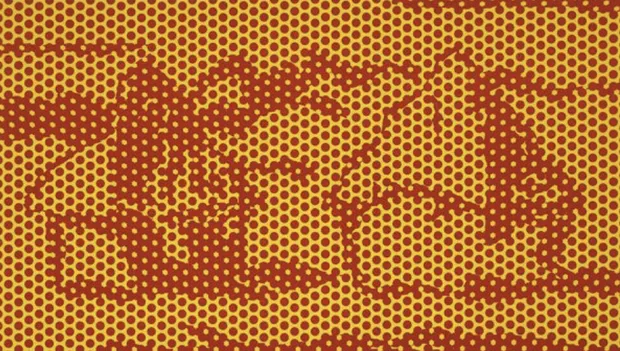
Haystack #6, State III, 1969: Print by Roy Lichtenstein from the Haystack series

  • Haystack #6, State III, 1969 lithograph by Roy Lichtenstein
    Haystack #6, State III, 1969
    Lithograph on Special Arjomari paper, sheets: 52.5 x 77.8 cm
    Edition of 13; plus 1 RTP
    ©The Estate of Roy Lichtenstein
     
    BACK TO: HAYSTACK & CATHEDRAL SERIES
     
    Roy Lichtenstein’s Haystack #6, State III, 1969, presents a vibrant orange and red variation within the Haystack series, further developing his reinterpretation of Claude Monet’s iconic motif. Constructed using Ben-Day dots, the composition is defined through subtle tonal shifts between warm hues, where the haystack forms emerge from the interplay of orange and red rather than strong contrast. The result is a softer, more unified surface compared to earlier, higher-contrast states.
     
    By working within a narrow, warm colour range, Lichtenstein emphasises how minimal variation can still produce depth, structure, and atmosphere. The reduced contrast encourages closer viewing, as the forms are less immediately distinct and instead revealed through pattern and repetition. This state highlights Lichtenstein’s systematic exploration of colour, demonstrating how controlled shifts in palette can transform both the legibility and emotional tone of the image.
  • People think one-point and two-point perspective is how the world actually looks, but of course, it isn’t. It’s a convention.


    - Roy Lichtenstein

    Using Ben-Day dots, flat colour, and controlled printmaking techniques, Lichtenstein replaces Monet’s expressive brushwork with a system of repetition and standardisation. Across the series, variations in colour shift the mood from light to dark, demonstrating how perception can be altered through minimal changes. In doing so, Lichtenstein bridges art history and mass production, presenting a modern, graphic exploration of light, colour, and reproduction.