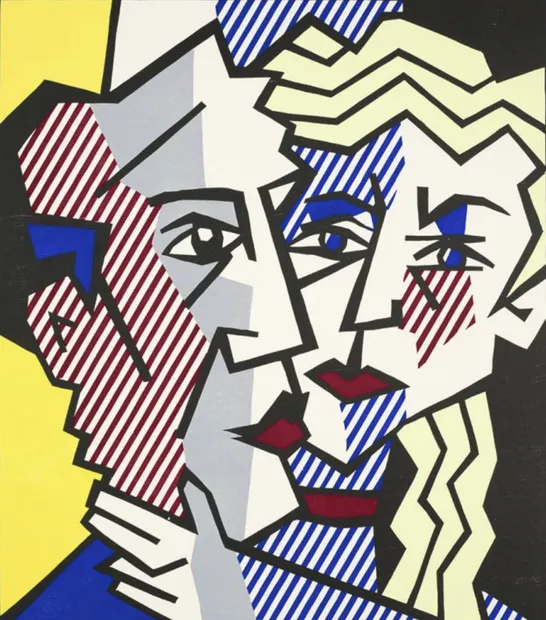
The Couple, 1980: Print from the Expressionist Woodcut series

  • The Couple, 1980 is a woodcut by Roy Lichtenstein depicting a couple embraing each other
    The Couple, 1980
    Woodcut with embossing on Arches Cover paper, sheet: 101.9 x 91.3 cm
    Edition of 50; plus 13 AP, 1 RTP, 1 PPII, 7 SP, 3 GEL, 1 C
    ©The Estate of Roy Lichtenstein
    BACK TO: EXPRESSIONIST WOODCUT SERIES
     
    Roy Lichtenstein’s The Couple, 1980, depicts a man and woman in a close, intimate embrace, rendered through bold colour and simplified geometric forms. The man, positioned in the foreground, is defined by a long, angular profile composed of red and white stripes alongside areas of grey and white. His dark hair, with hints of blue, sits behind the head, while a single eye and bright red lips define the front of his face. Behind him, the woman reaches forward, her hand resting against his face, reinforcing the sense of closeness between the two figures.
     
    The woman’s face is constructed from blue and white stripes, with her cheek formed from red and white bands that echo the visual language used throughout the composition. Her bright blue eyes and vivid red lips stand out against the structured geometry of her features, while her long blonde hair flows alongside the face. The background is composed of bold areas of yellow, white, and black, creating a strong contrast that frames the figures. Executed as part of Lichtenstein’s Expressionist Woodcut series, The Couple reflects his reinterpretation of emotional subject matter through a controlled, graphic style that balances expressive content with precise, structured form.
  • "I don't have big anxieties. I wish I did. I'd be much more interesting." 


    - Roy Lichtenstein

    In the Expressionist Woodcut series, Lichtenstein’s use of primary colours plays a key role in simplifying and structuring the compositions. Strong reds, blues, and yellows replace naturalistic colour, allowing the figures and forms to be defined through bold contrast rather than subtle shading. These flat, highly saturated colours enhance the graphic clarity of the images and emphasise their constructed, almost mechanical appearance.