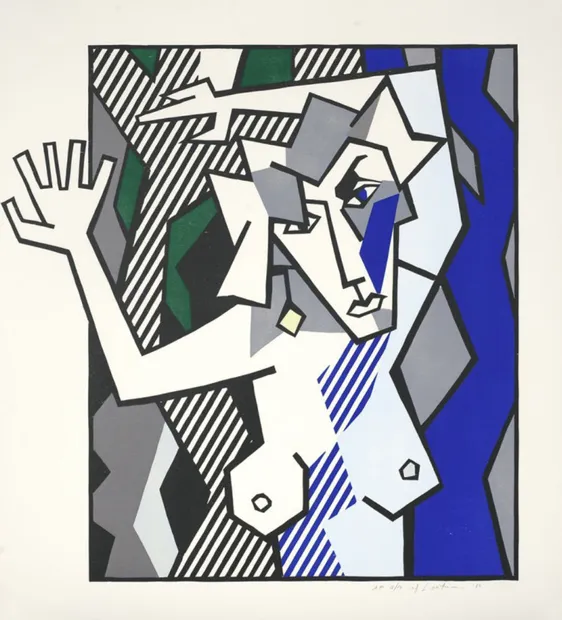
Nude in the Woods, 1980: Print by Lichtenstein from the Expressionist Woodcut series

  • Nude in the Woods, 1980, is a print by Roy Lichtenstein showcasing a nude woman dancing in a forest

    Nude in the Woods, 1980

    Woodcut with embossing on Arches Cover paper, sheet: 101 x 90.5cm 

    Edition of 50; plus 13 AP, 1 RTP, 1 PPII, 3 GEL, 1 C, 3 SP

    ©The Estate of Roy Lichtenstein

    BACK TO: EXPRESSIONIST WOODCUT SERIES


    Roy Lichtenstein’s Nude in the Woods, 1980, depicts a standing female figure with her arms raised and hands open, rendered through bold outlines and simplified forms. The head is angular, defined by strong black lines that shape the face and features. A bright blue stripe along the right side of the cheek and a vivid blue eye add contrast within the otherwise limited palette. The hair appears spiked and stylised, composed of grey and white blocks that emphasise the graphic structure of the figure. Across the body, Lichtenstein introduces bands of blue and white stripes that divide the torso and create areas of tonal variation, while pale blue shapes add further definition along the right side of the figure.
     
    Behind the figure, the background is filled with a textured field of colour composed of varying shades of blue, grey, and green. This layered surface contrasts with the sharply defined lines of the figure, giving the composition depth while maintaining the bold graphic clarity characteristic of the series. Executed as a woodcut with embossing on Arches Cover paper, Nude in the Woods belongs to Lichtenstein’s Expressionist Woodcut series of 1980. In these works, the artist reinterprets the dramatic contrasts and carved textures associated with German Expressionist prints through his own distinctive Pop Art vocabulary.
  • "I'm trying to make paintings like giant musical chords, with a polyphony of colours that is nuts but works."


    - Roy Lichtenstein

    Rather than depicting the body in a naturalistic way, he simplifies the form into angular shapes, strong outlines, and flat areas of colour. The figure is constructed through clear geometric divisions and bold contrasts, which emphasise structure over realism. By reducing the body to these simplified forms, Lichtenstein transforms the traditional subject of the nude into a highly stylised image that reflects both the expressive qualities of woodcut printmaking and the clean visual vocabulary of Pop Art.