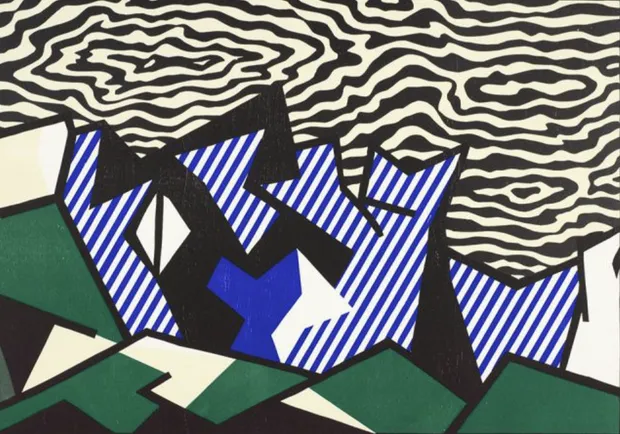
Morton A. Mort, 1980: Print by Lichtenstein from his Expressionist Woodcut series

  • Morton A. Mort is a print on paper by Roy Lichtenstein from his 1980 series Expressionist Woodcut

    Morton A. Mort, 1980

    Woodcut with embossing on Arches Cover paper, sheet: 74.3 x 99.1cm 

    Edition of 50; plus 13 AP, 1 RTP, 1 PPII, 3 GEL, 1 C, 2 SP

    ©The Estate of Roy Lichtenstein

    BACK TO: EXPRESSIONIST WOODCUT SERIES


    Lichtenstein’s Morton A. Mort, 1980, presents a stylised portrait of a man shown reclining on his back. The profile of the face is highly graphic and angular, creating a dramatic silhouette that almost resembles a mountainous landscape. The face itself is rendered in white and blue stripes, while the forehead, nose, and sharply opened mouth are defined by thick black outlines that emphasise the strong structure of the figure. These bold lines give the portrait a carved, sculptural quality that echoes the traditional woodcut process.
     
    Beneath the face, a series of deep green and white geometric blocks form the shoulders and lower section of the composition, arranged in bold, simplified shapes. Behind the figure, the background is filled with a black and white woodcut pattern that contrasts with the striped face and adds visual texture to the print. Executed as a woodcut with embossing on Arches Cover paper, Morton A. Mort forms part of Lichtenstein’s Expressionist Woodcut series from 1980, in which the artist reinterprets the dramatic forms and strong contrasts associated with German Expressionist printmaking through his distinctive Pop Art style.
  • "My work isn't about form. It's about seeing." 


    - Roy Lichtenstein

    Inspired by early twentieth century German Expressionist artists, who used woodcut to create bold contrasts and dramatic forms, Lichtenstein adopted the technique while reinterpreting it through his own graphic style. Rather than embracing the rough, spontaneous quality often associated with Expressionist prints, he carefully controlled the carved lines and large areas of colour to achieve a precise, almost mechanical appearance. In doing so, Lichtenstein both references and reexamines the historical woodcut tradition, combining its expressive visual language with the clarity and structure characteristic of his Pop Art practice.