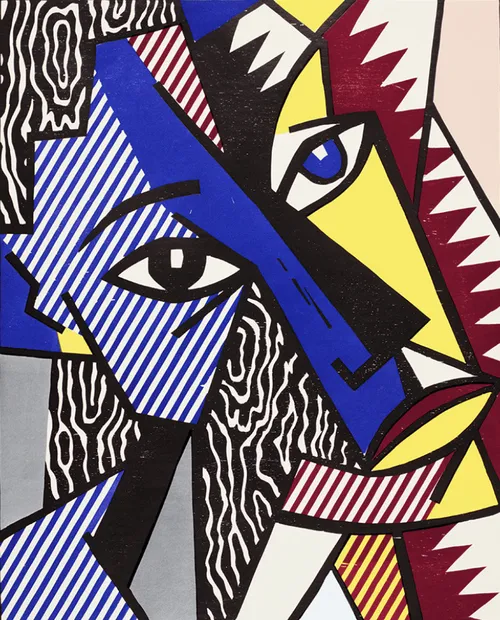
Head, 1980: Woodcut print from the Expressionist Woodcut series

  • Head, 1980 is a woodcut on paper by Roy Lichtenstein that displays a head with facial features

    Head, 1980

    Woodcut with embossing on Arches Cover paper, sheet: 101.3 x 85.4cm 

    Edition of 50; plus 9 AP, 1 TP, 1 RTP, 1 PPII, 3 GEL, 1 C, 1 SP

    ©The Estate of Roy Lichtenstein


    BACK TO: EXPRESSIONIST WOODCUT SERIES
     
    Lichtenstein’s Head, 1980, presents a stylised portrait rendered through bold colour and simplified graphic forms. The figure faces toward the right, with the head constructed from a series of geometric shapes that define the facial features. Two eyes sit prominently within the composition, one with a black iris and the other with a bright blue iris, creating a subtle visual contrast. The nose is formed from simple black lines, while the mouth is composed of red and yellow shapes. Beneath this, the chin is defined by red and white stripes alongside a bright yellow section, emphasising the layered structure of the face.
     
    The neck and shoulders introduce additional patterns and textures that contrast with the brightly coloured head. The neck appears in dark woodcut tones, while the shoulders are rendered in blue and white stripes. Behind the figure, a panel filled with red and white spiked patterns forms a striking backdrop that frames the head and heightens the graphic intensity of the composition. Executed as a woodcut with embossing on Arches Cover paper, Head belongs to Lichtenstein’s Expressionist Woodcut series of 1980, in which the artist reinterpreted the bold forms and dramatic contrasts of German Expressionist prints through his distinctive Pop Art vocabulary.
  • I’d always wanted to know the difference between a mark that was art and one that wasn’t.


    - Roy Lichtenstein

    In the Expressionist Woodcut series, Roy Lichtenstein draws inspiration from the bold forms and dramatic contrasts associated with German Expressionist printmaking. Using the traditional woodcut technique, he adopts the strong outlines and simplified forms typical of Expressionist works, while maintaining the clean lines and flat colours characteristic of his own Pop Art style. The result is a series of prints that reference the expressive qualities of early twentieth-century woodcuts while reflecting Lichtenstein’s interest in precision, graphic design, and controlled composition.