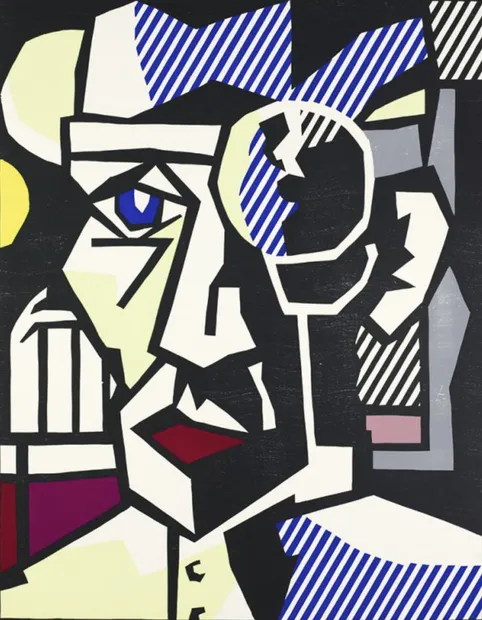
Dr Waldmann, 1980: Woodcut on paper by Roy Lichtenstein

  • Dr. Waldmann, 1980, Roy Lichtenstein

    Dr. Waldmann, 1980

    Woodcut with embossing on Arches Cover paper, sheets: 105.7 x 87cm 

    Edition of 50; plus 13 AP, 1 RTP, 1 PPII, 3 GEL, 1 C, 7 SP

    ©The Estate of Roy Lichtenstein


    BACK TO: EXPRESSIONIST WOODCUT SERIES


    Lichtenstein’s Dr. Waldmann, 1980, presents a stylised portrait of a man shown in profile, looking toward the left. The face is constructed from bold geometric shapes and strong graphic outlines that define the features with clarity. The eye is rendered in bright blue with a white centre, while the nose is formed through simple black lines and the lips appear in a vivid red. A small circular monocle frames the right eye, adding a distinctive detail to the figure. Across the upper section of the forehead, blue and white stripes introduce a patterned area that contrasts with the flatter colour fields that make up the rest of the face.
     
    Behind the head, a dark black background provides a strong contrast that allows the figure to stand out prominently. The figure’s shoulders extend below the head, with the left side rendered in yellow and the right side filled with blue and white stripes that echo the pattern across the forehead. Executed as a woodcut with embossing on Arches Cover paper, Dr. Waldmann belongs to Lichtenstein’s Expressionist Woodcut series, in which the artist reinterprets the visual language of early twentieth century German Expressionist prints through the bold colours, simplified forms, and graphic clarity associated with Pop Art.
  • "Actually, I love the Abstract Expressionists – or I like the ones I like, anyway.”


    - Roy Lichtenstein

    Lichtenstein’s Expressionist Woodcut series emerged from his growing interest in German Expressionist printmaking, sparked by a visit in 1978 to the Robert Gore Rifkind Collection of German Expressionist graphic art in Los Angeles. After studying the works and discussing printmaking with the collector, Lichtenstein began exploring the visual language of German Expressionism in both painting and print.