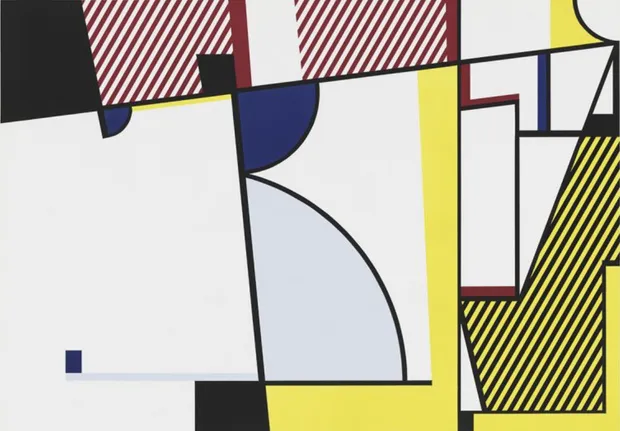
BULL V, 1973: Roy Lichtenstein print from the Bull Series

  • Bull V, 1973 is a lithograph, screenprint and linecut by Roy Lichtenstein from his Bull Profile series depicting an abstract bull

    Bull V, 1973

    Lithograph, screenprint, and linecut on Arjomari paper, sheet: 68.7 x 89cm

    Edition of 100; plus 13 AP, 1 RTP, 1 PPII, 3 GEL, 1 C

    ©The Estate of Roy Lichtenstein

    BACK TO: BULL PROFILE SERIES


    Roy Lichtenstein’s Bull V, 1973, pushes the simplification of the bull motif even further, reducing the figure to a sparse arrangement of geometric shapes and graphic lines. The elements that once clearly suggested the animal’s form are now almost entirely abstracted. Only fragments of the bull remain recognisable, most notably the horn positioned at the top right of the image. The head is suggested through a series of red, blue, and black lines that form a slightly downward angled shape, hinting at the posture of the animal while avoiding any detailed representation. What remains is a geometric structure that only loosely recalls the body of a bull.
     
    Behind the simplified figure, the background is composed of bold colour fields and patterns that echo motifs used throughout the earlier prints in the series. Bright yellow areas intersect with black linear elements, while red and white stripes add visual rhythm to the composition. These graphic devices remain consistent with earlier works in the Bull Profile series, yet here they dominate the composition as the bull itself becomes increasingly minimal. Produced using lithograph, screenprint, and linecut on Arjomari paper, Bull V continues Lichtenstein’s exploration of how far a figurative subject can be reduced before it dissolves into pure abstraction.
  • "I'd always wanted to know the difference between a mark that was art and one that wasn't." 

    - Roy Lichtenstein

    Lichtenstein’s use of primary colours reinforces the overall simplification of the image. Bold reds, blues, and yellows replace any naturalistic colouring of the animal, reducing the palette to its most basic visual elements. This limited use of colour mirrors the geometric reduction of the bull itself, allowing the composition to rely on clear contrasts and flat areas of colour rather than tonal variation.