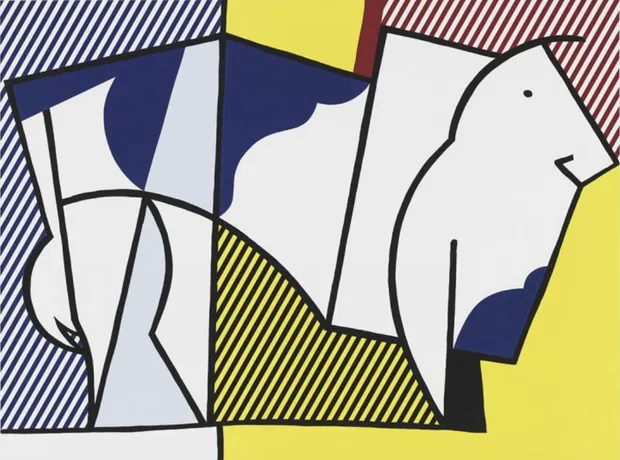
BULL III, 1973: Print by Roy Lichtenstein in his Bull Profile series

  • Bull III, 1973 lithograph, screenprint and linecut by Roy Lichtenstein depicting a abstract bull with blue patches on a brightly coloured background.

    Bull III, 1973

    Lithograph, screenprint, and linecut on Arjomari paper, sheet: 68.6 x 89 cm 

    Edition of 100; plus 13 AP, 1 RTP, 1 PPII, 3 GEL, 1 C

    ©The Estate of Roy Lichtenstein

    BACK TO: BULL PROFILE SERIES


    Roy Lichtenstein’s Bull III, 1973, presents the bull in a further simplified form, reducing the animal into a series of bold geometric shapes. The head and body are constructed from rectangular forms outlined with thick black lines, creating a highly structured composition. The bull’s body remains largely white, while flat blue shapes introduce areas of shadow across the back and middle sections. The facial features are reduced to minimal graphic marks, with a single black dot forming the eye, a short line indicating the mouth, and a simple curved line suggesting the ear and horn. Through this reduction, the bull remains identifiable while becoming increasingly schematic.
     
    The background reinforces the print’s graphic clarity through distinct colour fields. Bull III forms part of Lichtenstein’s Bull Profile series, produced in 1973, in which the artist progressively simplified the image of the bull across multiple prints. Created using lithograph, screenprint, and linecut on Arjomari paper, the work demonstrates Lichtenstein’s interest in combining different printmaking techniques to achieve strong colour contrasts and bold graphic forms.
  • "Use the worst colour you can find in each place - it usually is the best."


    - Roy Lichtenstein

    Unlike Picasso’s gradual process of discovery in Le Taureau, where the image was repeatedly altered directly on the lithographic stone through erasure and redrawing, Lichtenstein’s Bull Profile series was carefully pre-planned. The sequence of simplifications was not the result of an evolving search for the essential form of the bull, but instead developed from collages and preparatory drawings made in advance. In this way, Lichtenstein approaches the tradition of artistic reduction with a degree of irony.