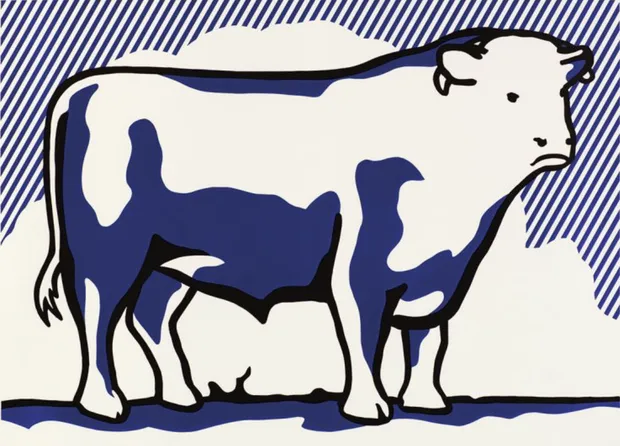
BULL II, 1973: Lithograph & linecut print by Roy Lichtenstein

  • Bull II, 1973, is a print by Roy Lichtenstein depicting a blue bull
    Bull II, 1973
    Lithograph and linecut on Arjomari paper, sheet: 68.6 x 88.9 cm
    Edition of 100; plus 13 AP, 4 TP, 1 RTP, 1 PPII, 3 GEL, 1 C
    ©The Estate of Roy Lichtenstein
    BACK TO: BULL PROFILE SERIES
     
    Lichtenstein’s Bull II, 1973, is the second print from the Bull Profile series that shows the artist beginning to simplify the image of the bull following the more detailed black and white rendering of Bull I. The animal is defined by a thick black outline that clearly traces the contours of its body. Within this outline, areas of shading are reduced to flat fields of blue, replacing the linear texture seen in the previous work. The bull’s face is constructed from simple black shapes set against a white ground, forming the eyes, nose, ears, and mouth with minimal detail. Behind the figure, the background is composed of blue and white stripes, while a blue shape beneath the animal suggests its shadow.
     
    Bull II continues Lichtenstein’s exploration of how a figurative subject can be gradually simplified into graphic forms. Produced using a combination of lithograph and linecut on Arjomari paper, the print reflects the artist’s interest in combining traditional printmaking techniques with the bold visual language associated with Pop Art. By reducing tonal variation and introducing flat areas of colour, Lichtenstein moves the image further away from naturalistic representation and towards a more graphic interpretation of the bull. 
  • "My work isn't about form. It's about seeing." 

     
    - Roy Lichtenstein
    Lichtenstein simplifies the use of colour by replacing the tonal variations seen in Bull I with flat areas of blue. Rather than building form through shading or texture, the artist introduces a single, uniform colour field within the bull’s body. This shift towards flat colour reinforces the graphic quality of the image and aligns with Lichtenstein’s broader Pop Art approach, where bold, simplified colour replaces naturalistic modelling.