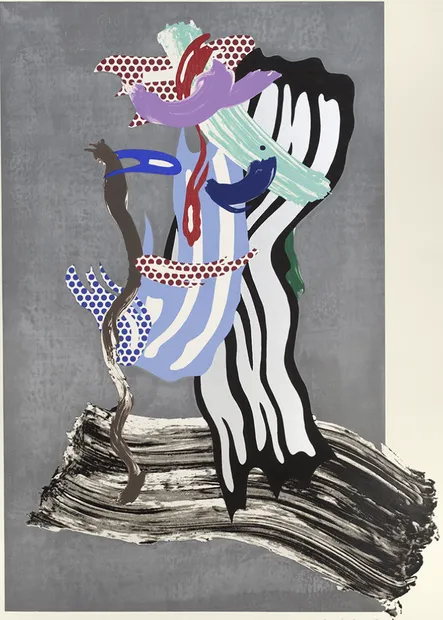
Grandpa, 1989: Lithograph from Roy Lichtenstein's Brushstroke Figures series

  • Grandpa, 1989 is a print by the artist Roy Lichtenstein from his Brushstroke figures series

    Grandpa, 1989

    Lithograph, waxtype, woodcut, and screenprint on 638-g/m² cold-pressed Saunders Waterford paper, sheet: 144.3 x 104.1 cm (irregular)

    Edition of 60; plus 1 BAT, 2 PP, 2 Presentation Proofs, 1 NGA archive proof, 1 Graphicstudio Proof, 1 USFP, 2 SP, 8 AP

    ©The Estate of Roy Lichtenstein

    BACK TO: BRUSHSTROKE FIGURE SERIES


    Roy Lichtenstein’s Grandpa, 1989, is a striking work from the Brushstroke Figures series, where the human head is constructed entirely from expressive painterly marks. Set against a mottled grey background, the grinning figure tilts its chin upward, revealing a red Ben-Day dot smile. The widely spaced eyes, one open and the other closed, create a playful, exaggerated expression. A thin nose runs down the centre of the face in a single brushstroke, while the hair is composed of vibrant teal and purple strokes accented with red Ben-Day dots. The back of the head and neck dissolve into darker black and grey brushstrokes, with a broad stroke extending across the lower edge of the composition.
     
    Executed in lithograph, waxtype, woodcut and screenprint on heavy Saunders Waterford paper, the print demonstrates the layered technical approach Lichtenstein used in his late printmaking practice. Published by Waddington Graphics, London, and Graphicstudio at the University of South Florida, Tampa, and issued in a limited edition of 60 with additional proofs, Grandpa highlights Lichtenstein’s exploration of the brushstroke as both form and subject within the language of Pop Art.
  •  “Organised perception is what art is all about.


    - Roy Lichtenstein

    In Grandpa, 1989, Roy Lichtenstein combined several printmaking techniques to achieve a layered and highly controlled surface. Lithography captures the fluidity of the drawn brushstrokes, while screenprint allows for the flat fields of colour and precise Ben-Day dots that define the face. Woodcut introduces stronger graphic edges and texture, and waxtype adds subtle tonal variation. By merging these processes within a single print, Lichtenstein was able to simulate the energy of painted brushwork while retaining the crisp precision and reproducibility of a printed medium.