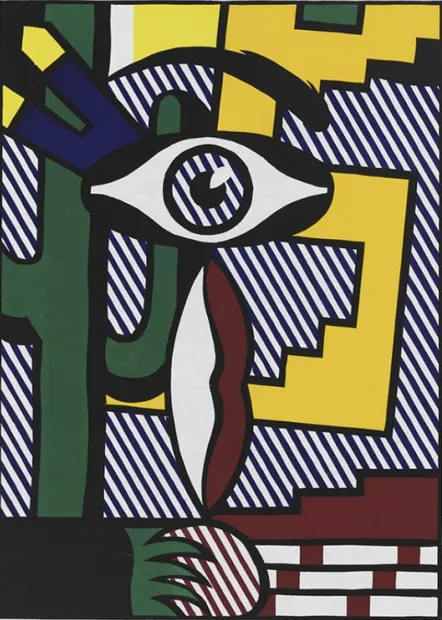
AMERICAN INDIAN THEME III, 1980: Print from the American Indian Theme series

  • American Indian Theme III, 1980 is a print on paper by Roy Lichtenstein showcasing an eye in the centre of the artwork next to a cactus
    American Indian Theme III, 1980
    Woodcut on handmade Suzuki paper, sheet: 88.9 x 68.6 cm (irregular)
    Edition of 50; plus 18 AP, 1 RTP, 1 PPI, 1 PPII, 1 A, 1 C (and 1 teaching-aide proof)
    ©The Estate of Roy Lichtenstein
    BACK TO: AMERICAN INDIAN THEME SERIES


    Roy Lichtenstein’s American Indian Theme III, 1980, centres on a striking eye motif that dominates the composition. The eye features a blue and white striped iris framed by a bold black outline, with a curved black line above suggesting an eyebrow. Surrounding this central element, Lichtenstein arranges a series of graphic shapes and symbols that create a layered and dynamic composition. To the left of the eye stands a deep green cactus form, while beneath it red and white patterned shapes introduce additional texture and rhythm to the image.
     
    Below the eye, a red and white lip shaped form appears turned on its side, adding to the stylised, symbolic quality of the composition. Behind these elements, the background is filled with blue and white diagonal stripes intersected by a large yellow geometric shape that cuts across the right side of the image. Created as a woodcut, American Indian Theme IIIdemonstrates Lichtenstein’s interest in combining bold colour, geometric structure, and decorative pattern. As part of the American Indian Theme series, the print reinterprets visual motifs associated with Indigenous design through the graphic language of Pop Art.
  • "I'm trying to make paintings like giant musical chords, with a polyphony of colours that is nuts but works." 
     
    - Roy Lichtenstein
    Lichtenstein’s American Indian Theme series, produced in 1980, explores imagery associated with Native American visual culture through the bold graphic language of Pop Art. Across the series, the artist brings together stylised motifs such as feathers, masks, textiles, and geometric patterns, reinterpreting them through simplified forms and flat blocks of colour. Executed as woodcuts, the prints combine strong outlines, repeated patterns, and vivid colour contrasts to create visually striking compositions.