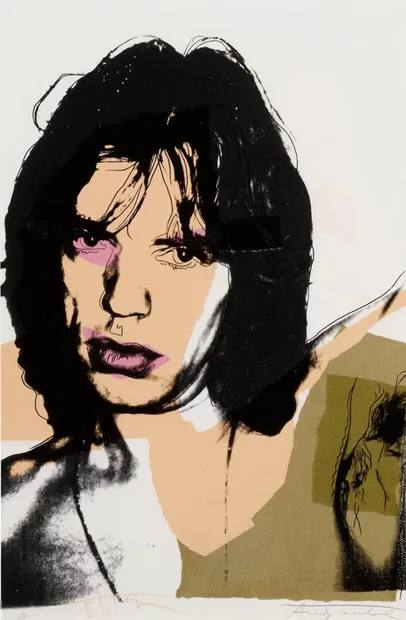
MICK JAGGER (F. & S. II.141), 1975: Print by Andy Warhol

  • Andy Warhol Mick Jagger (F. & S. II.141) 1975 screenprint portrait with bold black line, pink facial highlights and layered colour blocks, signed edition of 250
    Mick Jagger (F. & S. II.141), 1975

    Screenprint on paper, H 110cm X W 73cm

     Edition of 250, 50 AP, 3 PP 

    ©The Andy Warhol Foundation

    BACK TO: MICK JAGGER

    Andy Warhol’s Mick Jagger (F. & S. II.141), 1975, presents a more direct and intensified portrait within the Mick Jagger series, characterised by its bold contrasts and heightened facial detail. Warhol emphasises Jagger’s features through strong black line and shadow, punctuated by vivid pink tones around the eyes and lips. The composition is built through layered blocks of muted colour, including soft beige and olive tones, which both frame and disrupt the portrait, reinforcing the tension between clarity and abstraction.
     
    The work captures Jagger’s distinctive expression while simultaneously stylising it, transforming the musician into a constructed visual icon. Produced as a screenprint in an edition of 250, with additional artist’s proofs, impressions are typically signed by both Mick Jagger and Andy Warhol. This composition stands out within the series for its focus on facial intensity and reduced fragmentation, offering a more concentrated interpretation of Warhol’s approach to celebrity portraiture in the mid-1970s.
  • "If it doesn't make sense it's art" 

    - Andy Warhol

    Mick Jagger is one of the most iconic figures in modern music, best known as the lead singer of the Rolling Stones. Rising to prominence in the 1960s, he became synonymous with the energy and rebellion of rock culture, defined by his distinctive voice, stage presence, and enduring public image. Beyond music, Jagger’s influence extends into fashion and popular culture, where his persona has remained instantly recognisable across decades. This combination of charisma and visual identity made him a compelling subject for artists like Andy Warhol, who saw in Jagger a powerful embodiment of celebrity as image.